

Customers, sites and equipment
Link each request and work order to the right customer location and, where relevant, an equipment record. Keep service history connected when records are archived.
Field service & contractors
Connect the request, estimate, technician appointment and recorded findings. Give office and field teams a workflow they can follow and a closeout record they can understand.
A request can start in a phone call, become a quotation in a document and finish as a technician note that never reaches the office. When equipment and visit history are disconnected, the next person starts by asking the same questions again. A service workflow should keep those handoffs connected.
The right scope depends on your work: HVAC maintenance, electrical inspections, repairs or another service model. We distinguish a planned appointment from actual work, an estimate from a bill and a recorded defect from the action that resolves it.
Possible solution modules
These are capabilities to scope around your operation, not a fixed bundle of connected services.
Link each request and work order to the right customer location and, where relevant, an equipment record. Keep service history connected when records are archived.
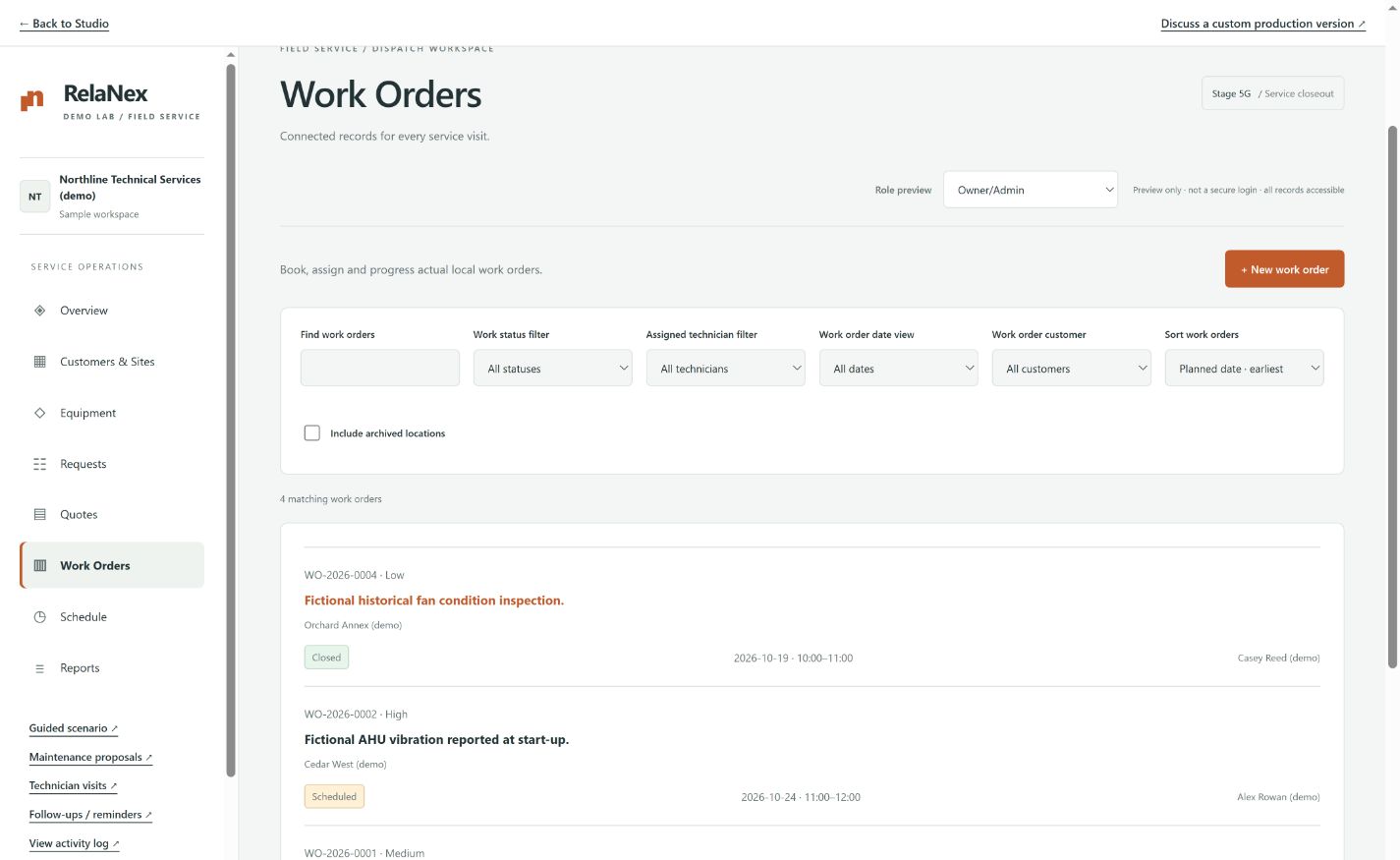
Track the initial complaint and estimate decision, then create one linked job. Scheduling rules can check technician skills, working hours and overlapping appointments.
Use suitable checklists and require the details needed for completion. Record readings, exceptions, labor and materials without inventing missing observations or costs.
Produce a service report from saved findings and retain open corrective actions. Maintenance proposals and financial handover can be designed around recorded evidence and explicit unknowns.
How the work takes shape
Review your request intake, quotation, scheduling, field checklist and closeout documents. Identify where information currently gets copied or lost.
Test a scheduling conflict, a partially completed visit and a failed finding that needs follow-up. Agree what should prevent completion and what should remain editable.
Scope accounts, permissions, server data, backups and any accounting, calendar or messaging connections. Mobile requirements and connectivity constraints belong in that discussion.
An honest example
The working demo includes requests, estimates with simulated approval, conflict-checked dispatch, HVAC/electrical recording templates, saved labor and materials, follow-ups, maintenance proposals and genuine PDF reports. Fictional Northline records stay in this browser. It does not send messages, track GPS, collect payments or create accounting invoices.
Questions before you begin
Yes. The demo generates a binary PDF from saved service evidence. It is labelled as fictional demo data and contains no verified signature or customer acceptance.
No. Sent and approval are simulated local estimate states. Delivery, customer identity and approval capture would need an agreed production integration.
No. They demonstrate structured recording and completion rules. Production procedures, acceptance criteria and any required professional approvals must be defined by the service business.
The demo keeps unknown costs distinct from recorded zero costs and blocks inappropriate comparisons. Accounting rates, taxes and invoicing would be separate requirements.
Your next step
A short brief is enough to begin a discovery conversation. Tell us about the current process, the people involved and the outcome you need.
Start your brief ↗